

 English
 中文简体
中文简体

Content
- 1 What Velvet Ultrasonic Quilt Fabric Actually Is
- 2 How the Ultrasonic Quilting Process Works
- 3 Key Properties That Define This Fabric's Performance
- 4 Comparing Ultrasonic Quilted Velvet to Conventionally Sewn Quilted Velvet
- 5 Primary Applications and End Uses
- 6 Standard Specifications and What They Mean for Buyers
- 7 Care Instructions and Wash Performance
- 8 What to Evaluate When Sourcing Velvet Ultrasonic Quilt Fabric
Velvet ultrasonic quilt fabric has established itself as one of the most sought-after materials in the premium bedding, upholstery, and home textile industries. Combining the luxurious surface texture of velvet with the structural precision of ultrasonic bonding technology, this fabric delivers a product that is visually striking, dimensionally stable, and commercially practical to produce at scale. Whether you are a textile buyer sourcing materials for a bedding brand, an interior designer specifying throw blankets and decorative quilts, or a manufacturer evaluating fabric options for a new product line, understanding the full picture of velvet ultrasonic quilt fabric — from how it is made to how it performs in real-world use — is essential for making confident decisions.
What Velvet Ultrasonic Quilt Fabric Actually Is
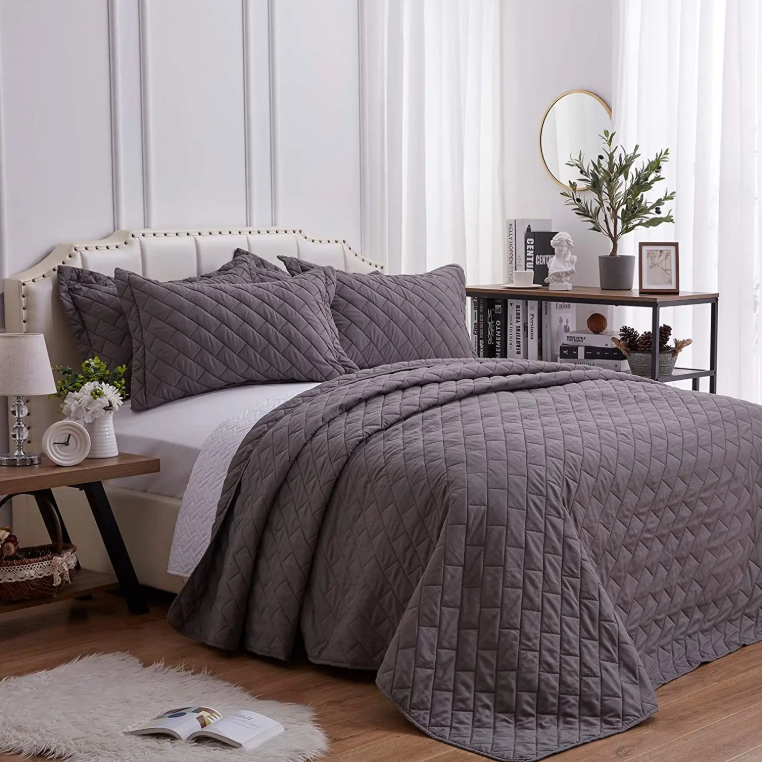
Velvet ultrasonic quilt fabric is a multi-layer textile construction in which a velvet face fabric is bonded to one or more inner layers — typically a polyester fiberfill batting and a backing fabric — using ultrasonic welding technology rather than traditional needle-and-thread quilting. The result is a fabric that has the characteristic soft pile surface of velvet on one or both faces, with a quilted pattern of fused channels or geometric shapes running across its surface, creating both visual depth and structural integrity without any visible stitching.
The velvet component used in this construction is almost exclusively a synthetic velvet — most commonly a warp-knit polyester velvet or a weft pile velvet made from polyester or polyester-nylon blends. Natural silk velvet, while luxurious, is incompatible with ultrasonic welding because the process requires thermoplastic materials that melt and fuse under ultrasonic energy. Polyester is the ideal fiber for ultrasonic quilting precisely because it melts cleanly at controlled temperatures without burning, charring, or releasing harmful compounds under the high-frequency vibration of the ultrasonic horn.
How the Ultrasonic Quilting Process Works
Ultrasonic quilting is a thermal bonding process that uses high-frequency mechanical vibration — typically in the 20–40 kHz range — to generate localized frictional heat at the points where fabric layers are compressed between a patterned rotary die (the embossing wheel) and an anvil roller. When the ultrasonic horn transmits vibrational energy through the fabric stack, the thermoplastic fibers at the compression points heat up rapidly and melt together, forming a permanent fused bond as the material cools and resolidifies within milliseconds.
The process runs continuously at high speed — modern ultrasonic quilting machines process fabric at 5 to 15 meters per minute depending on material thickness and pattern complexity. The patterned rotary die determines the quilted design: it can produce diamond grids, floral motifs, geometric shapes, wavy lines, or custom branded patterns. Because the pattern is determined by the die rather than by needle movements, complex and intricate designs that would be extremely time-consuming to sew can be produced at full production speed with no additional labor cost. The die-imprinted fusion points are permanent, dimensionally precise, and will not unravel or distort even under repeated washing.
Key Properties That Define This Fabric's Performance
The combination of velvet pile construction and ultrasonic bonding creates a material with a distinctive set of performance characteristics that set it apart from both conventionally sewn quilted fabrics and standard velvet without quilting.
Surface Softness and Pile Quality
The surface softness of velvet ultrasonic quilt fabric is determined primarily by the pile height, pile density, and fiber fineness of the velvet face layer. Premium grades use microfiber polyester with individual fiber deniers as low as 0.1–0.3 dpf (denier per filament), producing a surface that rivals the tactile quality of natural materials while being significantly more durable and easier to care for. Pile heights typically range from 1mm to 4mm — shorter piles produce a sleek, peach-skin texture with high color saturation, while longer piles create a plush, cloud-like surface that is particularly desirable in throw blankets and winter bedding applications.
Thermal Insulation and Fill Weight
The inner batting layer — most commonly a siliconized polyester fiberfill with a weight of 100 to 400 gsm depending on the intended warmth level — provides the fabric's insulating function. The ultrasonic fusion channels divide the batting into discrete quilted chambers that prevent fill migration, ensuring the insulation remains evenly distributed across the fabric surface even after years of use and washing. This fill-stabilization function is particularly important in larger products such as comforters and throws, where fill clustering in corners is a common quality complaint in lower-end products using inferior bonding methods.
Dimensional Stability and Edge Integrity
Because ultrasonic quilting fuses the fabric layers together rather than stitching them, the bonded zones act as structural reinforcement across the entire fabric width. This gives velvet ultrasonic quilt fabric excellent dimensional stability — it resists stretching, distortion, and layer separation under mechanical stress. Cut edges sealed by the ultrasonic process do not fray, which reduces finishing requirements in manufacturing and allows clean decorative edges without additional binding or serging on certain product types.
Comparing Ultrasonic Quilted Velvet to Conventionally Sewn Quilted Velvet
| Property | Ultrasonic Quilted Velvet | Needle-Sewn Quilted Velvet |
| Seam appearance | Clean fused channels, no thread | Visible stitch lines, thread contrast |
| Pile surface disturbance | Minimal — pile lies flat around fused zones | Needle penetration compresses pile along stitch line |
| Production speed | High — 5–15 m/min continuous | Slower — limited by needle speed and thread management |
| Risk of seam failure | Very low — fused bond does not unravel | Thread breakage can cause seam unraveling |
| Pattern complexity | Unlimited — set by die design | Limited by needle movement programming |
| Wash durability | Excellent — bonds unaffected by washing | Good, but thread can weaken over multiple washes |
| Material compatibility | Thermoplastic fibers only (polyester) | Any fiber type including natural fibers |
Primary Applications and End Uses
Velvet ultrasonic quilt fabric is used across a wide range of product categories where the combination of visual luxury, structural performance, and manufacturing efficiency creates competitive advantage. The following are the most significant application areas:
- Comforters and duvet covers: The most volume-intensive application. Velvet ultrasonic quilt fabric is used as both the face fabric and the complete quilted shell in comforters ranging from lightweight summer versions with 100–150 gsm fill to heavy winter versions with 300–400 gsm fill. The ultrasonic quilted construction ensures fill stability throughout the product's lifespan, maintaining consistent warmth distribution without the fill-clustering issues that plague poorly quilted alternatives.
- Throw blankets and decorative quilts: Velvet ultrasonic quilted throws are among the best-selling home textile products in the mid-to-premium retail segment. The fabric's visual richness, pattern versatility, and immediate tactile appeal make it highly effective for gift retail, seasonal promotions, and lifestyle brand collections. Throws in this fabric consistently photograph well for e-commerce, with the pile surface and embossed pattern creating compelling product imagery.
- Upholstery and furniture accent panels: In furniture manufacturing, velvet ultrasonic quilt fabric is used for decorative panel inserts on headboards, sofa backs, ottomans, and storage benches. The fabric's dimensional stability and resistance to layer separation make it well-suited for upholstery applications where the fabric is stretched and stapled over frames without the risk of delamination at stress points.
- Pet bedding and luxury pet accessories: The premium pet product market has adopted velvet ultrasonic quilt fabric extensively for high-end pet beds, blankets, and carrier linings. The material's washability, softness, and visual appeal translate well into this category, and the ultrasonic bonding eliminates loose threads that could present ingestion risks for animals.
- Automotive and transportation interior textiles: Velvet ultrasonic quilted panels are used in premium automotive interior applications including seat back covers, headliner accents, door panel inserts, and cargo area liners in luxury vehicles. The precise pattern registration achievable with ultrasonic dies meets the exacting dimensional tolerances required by automotive interior design specifications.
Standard Specifications and What They Mean for Buyers
When sourcing velvet ultrasonic quilt fabric, buyers encounter a range of technical specifications that directly affect the fabric's suitability for their intended application. Understanding these parameters prevents costly specification mismatches.
Total Weight (GSM)
Total fabric weight in grams per square meter reflects the combined weight of the face velvet, inner batting, and backing fabric. Lightweight constructions for summer products typically run 200–280 gsm total, while mid-weight all-season products run 300–380 gsm, and heavy winter constructions reach 400–500 gsm or above. Weight directly correlates with material cost, so specifying the minimum weight that meets your thermal and hand-feel requirements avoids unnecessary cost premium.
Fabric Width
Standard production widths for velvet ultrasonic quilt fabric are typically 150cm, 160cm, 200cm, and 230cm, with wider widths suited to comforter and large throw production where minimizing seam count is desirable. Confirm available widths with your supplier early in product development, as not all ultrasonic quilting machines run all width formats, and width changes may require die adjustments that affect pattern repeat dimensions.
Pattern and Repeat Dimensions
The ultrasonic embossed pattern — whether diamond grid, floral, geometric, or custom — is defined by the die, and its repeat dimensions determine how the pattern aligns across a cut panel or finished product. For pattern-sensitive applications such as headboards or decorative pillows, confirm the pattern repeat dimensions relative to your cut panel size during the sampling stage to ensure the finished product displays the pattern symmetrically and intentionally rather than with awkward partial repeats at edges.
Care Instructions and Wash Performance
Polyester velvet ultrasonic quilt fabric is inherently easy to care for compared to natural fiber alternatives, but following correct laundering procedures preserves the pile quality and fabric appearance through repeated wash cycles.
- Machine wash in cold or warm water (30–40°C maximum) on a gentle or delicate cycle. High wash temperatures can cause slight shrinkage in the backing fabric and may affect the pile's directional alignment, producing a matted appearance after drying.
- Use mild liquid detergent without bleach or optical brighteners. Powder detergents can leave residue trapped in the pile that dulls color and creates a rough surface texture. Bleach and brightening agents degrade polyester dyes and reduce pile luster over time.
- Tumble dry on low heat or air dry flat. High dryer temperatures can cause the ultrasonic fusion bonds to soften slightly, potentially affecting the crispness of the embossed pattern definition. Air drying on a flat surface is the most conservative option for preserving both fabric structure and pile quality.
- Do not iron directly on the pile surface. Iron heat will flatten and permanently damage the velvet pile. If pressing is needed to smooth the backing or edges, use a low-temperature iron on the reverse side only, with a pressing cloth as a barrier.
- Brush the pile gently after washing using a soft-bristle fabric brush in the pile's natural direction to restore loft and directional sheen if the pile has been slightly matted during washing or drying.
What to Evaluate When Sourcing Velvet Ultrasonic Quilt Fabric
The market for velvet ultrasonic quilt fabric spans a wide quality range, from commodity-grade material produced at the lowest possible cost to premium constructions engineered for durability, color consistency, and exacting surface quality. Evaluating the following factors during the sourcing process helps identify suppliers and grades capable of meeting your product requirements consistently across production runs.
- Pile density and evenness: Request samples and examine the pile surface under raking light to reveal any thin areas, pile direction inconsistencies, or backing show-through that indicate lower pile density. Premium velvet should have a fully covered, uniform surface with no visible backing through the pile.
- Fusion bond strength: Test the peel strength of the ultrasonic bonds by attempting to separate the layers at a bonded channel. Quality bonding should require significant force to separate and should cause fiber tearing rather than clean delamination — clean delamination indicates insufficient energy during the ultrasonic welding process.
- Color fastness: Request test reports for wash fastness (ISO 105-C06) and rub fastness (ISO 105-X12) at minimum Grade 3–4 for wash and Grade 3 for wet rub. Velvet pile fabrics are particularly prone to surface color transfer due to the high surface area of exposed pile fibers, and below-specification fastness creates consumer complaints and returns.
- Pattern sharpness and registration: Examine the embossed pattern under magnification for edge definition at the fusion points. Sharp, well-defined pattern edges indicate correct die pressure and ultrasonic energy calibration. Blurred or inconsistent pattern edges suggest process parameter issues that may also indicate inconsistent bond strength across the fabric width.
- Production consistency across rolls: Request multiple roll samples from different production batches and compare them for color consistency, weight, and pile uniformity before committing to large volume orders. Roll-to-roll variation is a common quality issue in velvet production and becomes problematic when multiple rolls are cut and sewn together in a single finished product.
Velvet ultrasonic quilt fabric occupies a compelling position in the textile market — delivering visual luxury and tactile richness at production efficiencies that make it commercially viable across a wide range of price points. For buyers, designers, and manufacturers who understand its properties and sourcing criteria, it represents a genuinely versatile and durable material capable of elevating product quality in bedding, home décor, upholstery, and specialty textile applications alike.